Test maps are so essential to the overall process of mapping its almost laughable to think that I used to just start building my full map from scratch and wondered why i never got anywhere.
These days, for every map I produce, I create around 20-30 test maps.
If youve ever seen the process that film CGI goes through, test mapping is a lot like the pre-vis process. Basic shapes, functioning ideas and entities but none of the gorious source engine visual flare.
Here how i tend to put my test maps together and I can normally get everything up and running in less than 10 mins...
So you've got an idea for a new map area or style of gameplay and want to try it out.
My method for this tends to run along the following steps.
1: add an info player start and turn the cordon tool on.
2: build basic blocks to represent the required surfaces (do not spend any time on detail at all, do not bother sealing your map)
3: add in entities and start playing with them.
4: If combat area, review NPC behavior, rebuild blockmap until the NPCs are alive as long as possible. Whilst in combat, Npc behavior is at its best when they have multiple routes to choose from so add in walls, columns to make NPCs think more.
5: Once combat is good and lasts a while and youre happy with layout think about how the NPCs are introduced to the area... where does the player first lay eyes on them? Can you make that more interesting?
6. Lastly, try adding some additional elements to your map and see how it effects play.
Explosive barrels or tripmines etc are always fun for adding some randomness to a firefight.
Wednesday, 22 June 2011

A Feeling must be earned...
I base my maps on how I want the player to feel. I have ideas of huge revelations to the player, moment of intense emotions like fear, elation, power, revulsion, relief etc...
While I may never manage to actually get a player to feel these intense emotions I think if you aim for them youre on the right track.
What I've learned is that these feelings cant be achieved through quick scenarios, they must be earned through the map sections prior to that moment.
A stressed out player (who is having fun being stressed, hopefully) is much more likely to succumb to these feelings.
If your map is too easy, the player never feels in danger and therefore never emotionally invests in the game experience.
Bottom line... Im learning why all those twists and turns along the way are so necessary... its all about building up to these big moments.
Thursday, 16 June 2011
How I map for SP games
I use the following process for SP mapping but it probably applies somewhat to MP too.
When planning an SP map I think of it as a series of events you want the player to experience.
Make a list of your event ideas. These could be puzzles, fights, NPC story scenes etc...
Getting your events working
I pick the ideas that will suit the type of map I want to build best (keep the other ideas written down somewhere for another map at another time) and build small, working block test maps for each idea. Get all the entities working correctly.
This bit is soo much fun cos you can really experiment see what the entities are capable of.
This took about 10 mins to build in Hammer...
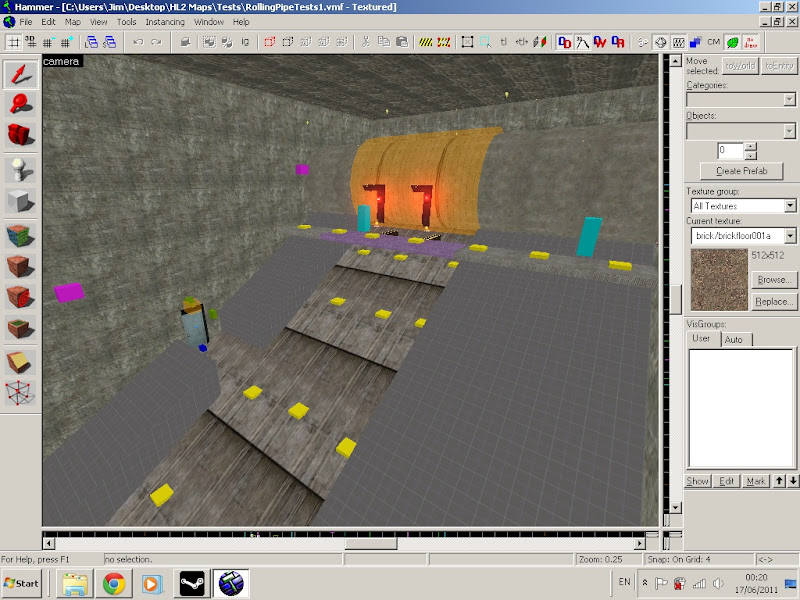
As you play with each test map, it should become clear how much space that idea needs and what sort of area shape gets the best results for that event. Dont even think about how it will look in the final map, just focus in the raw nuts and bolts of gameplay. Keep playing with the small test block maps until theyre working great. Send them to a playtester if you can to see if it makes sense and is fun.
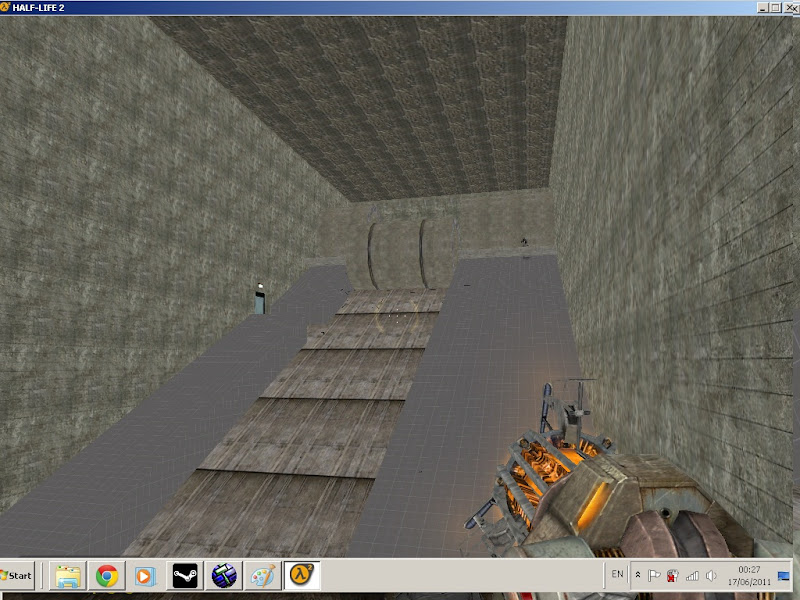
Here's how it looks in game...
The order of events
Once I've got these test maps working, I apply my brain as to which order the player should encounter the events in. Theres a flow to SP maps, too much action or too many puzzles can make maps dull. I mix them up into a decent varied order. The order might also depend on the story I'm trying to tell.
Translating your events to a game environment
Once I've got them in order, I apply my theme, city streets, sewers, etc...
I look at the testmaps and see how I can translate the shape of the blockmap to the theme.
Industrial spaces are easiest because theyre the most configurable (warehouses, crates etc.. ).
Now I either import my test maps into one main map or rebuild the space needed for each one and link them together (with corridors etc..). Now import the entities and move them into place. I apply basic textures and replace whatever blocks I can with prop_statics. I add basic lighting at this point too.
I try to save time on lighting by building a test map filled with prebuilt lights (grouped entities, models, sprites etc...) and dropping them into my map.
I find that new ideas will come to me as I link areas together. The links dont have to be just boring corridors either, add jumps, traps, minor npcs to them to keep the player on their toes.
Also I think about adding some safe areas too where the player can get their breath back.
Playtesting round 1
When I'm finished with this process I should have a playable map. At this point I get people to playtest it.
I get feedback and make changes to gameplay where necessary. I'm not afraid to pull my map apart at this point and rebuild. I've still got my test maps as a basic template for each area. I may or may not act on the playtester feedback, playtesters can have some weird ideas sometimes.
Detail pass 1
Once I've finished tweaking it, I start doing a 1st pass on detailing. I pull out walls, break up the blockiness with supports, curves, arches etc... anything to avoid having big flat walls and floors. I add in fake doors and dead end curves to make my map feel part of a larger world.
Also sort I sort my lighting out properly at this point. If my light templates were any good I shouldnt need to do much. I look at the lightmaps and if I see any groovy shadows that I want to make stronger I adjust the surfaces accordingly.
Detail pass 2
2nd pass at detailing I tend to sounds... its a really important step thats often missed but it gives a map depth and adds soo much to the player experience.
I then repeat these passes at detail improvement down to what ever level of detail I require.
At this point I would normally release it... I can always go back and do more work on it later and release again...
I try and avoid being a perfectionist or becoming obsessed with "finishing" a map. As the folks at Pixar say, "we don't finish our movies, just release them!".
Hope this is helpful...
When planning an SP map I think of it as a series of events you want the player to experience.
Make a list of your event ideas. These could be puzzles, fights, NPC story scenes etc...
Getting your events working
I pick the ideas that will suit the type of map I want to build best (keep the other ideas written down somewhere for another map at another time) and build small, working block test maps for each idea. Get all the entities working correctly.
This bit is soo much fun cos you can really experiment see what the entities are capable of.
This took about 10 mins to build in Hammer...
As you play with each test map, it should become clear how much space that idea needs and what sort of area shape gets the best results for that event. Dont even think about how it will look in the final map, just focus in the raw nuts and bolts of gameplay. Keep playing with the small test block maps until theyre working great. Send them to a playtester if you can to see if it makes sense and is fun.
Here's how it looks in game...
The order of events
Once I've got these test maps working, I apply my brain as to which order the player should encounter the events in. Theres a flow to SP maps, too much action or too many puzzles can make maps dull. I mix them up into a decent varied order. The order might also depend on the story I'm trying to tell.
Translating your events to a game environment
Once I've got them in order, I apply my theme, city streets, sewers, etc...
I look at the testmaps and see how I can translate the shape of the blockmap to the theme.
Industrial spaces are easiest because theyre the most configurable (warehouses, crates etc.. ).
Now I either import my test maps into one main map or rebuild the space needed for each one and link them together (with corridors etc..). Now import the entities and move them into place. I apply basic textures and replace whatever blocks I can with prop_statics. I add basic lighting at this point too.
I try to save time on lighting by building a test map filled with prebuilt lights (grouped entities, models, sprites etc...) and dropping them into my map.
I find that new ideas will come to me as I link areas together. The links dont have to be just boring corridors either, add jumps, traps, minor npcs to them to keep the player on their toes.
Also I think about adding some safe areas too where the player can get their breath back.
Playtesting round 1
When I'm finished with this process I should have a playable map. At this point I get people to playtest it.
I get feedback and make changes to gameplay where necessary. I'm not afraid to pull my map apart at this point and rebuild. I've still got my test maps as a basic template for each area. I may or may not act on the playtester feedback, playtesters can have some weird ideas sometimes.
Detail pass 1
Once I've finished tweaking it, I start doing a 1st pass on detailing. I pull out walls, break up the blockiness with supports, curves, arches etc... anything to avoid having big flat walls and floors. I add in fake doors and dead end curves to make my map feel part of a larger world.
Also sort I sort my lighting out properly at this point. If my light templates were any good I shouldnt need to do much. I look at the lightmaps and if I see any groovy shadows that I want to make stronger I adjust the surfaces accordingly.
Detail pass 2
2nd pass at detailing I tend to sounds... its a really important step thats often missed but it gives a map depth and adds soo much to the player experience.
I then repeat these passes at detail improvement down to what ever level of detail I require.
At this point I would normally release it... I can always go back and do more work on it later and release again...
I try and avoid being a perfectionist or becoming obsessed with "finishing" a map. As the folks at Pixar say, "we don't finish our movies, just release them!".
Hope this is helpful...
First ya get the gameplay, then ya get the looks, then ya get the women...
SP Level Design: The Player Experience
Here 10 thoughts to consider when designing your SP map.
I find that a lot of people focus on asthetics a little too much instead of how a map plays.
Here's some points from my experience so far while focussing on gameplay first and asthetics second...
1. Plan your map based on NPC behavior!
Pretty much every official map for every SP game is designed to get the best out of the NPC's in the game. This is often the reason SP games end up set in industrial areas or warehouses. These areas can absorb all manner of NPC encounters because crates can be stacked any way you like.
2. Test, Test, Test NPC behavior
In order to build good NPC encounters you need to know what they're capable of. By testing out NPCs in simple block maps you can really find some surprising and cool behaviors you didnt even know they were capable of.
Combine Soldiers are pretty smart, and its a shame to waste all that brilliant AI on a flat, boring firefight. They can move, flank, flush you out with grenades, they'll pop an explosive barrel if its near you and set up in the right way.
By understanding the limits of NPC behavior you can make your encounters really stand out.
3. Know the players expectations (then mess with them a little)
Players come to a custom SP with a set of expectations from the original game. They know how the Half-Life, Portal, world works, the puzzles, the items, the sounds, the look. Either stick with this or completely change it.
If you do stick to the game world try to mess with these expectations a little. For example, the player expect an item crate to contain... well items... they don't expect it to contain a live grenade ready to pop in 5 seconds.. or a headcrab!
If you're going to introduce new gameplay concepts to your map, make sure you introduce them to the player in a safe environment where they can play with the new element and learn how it works.
4. Take a break
Players need a rest every now and again. Make sure you add a safe area every now and again where they can get their breath back.
5. Instant death is evil
Give the player some warning before they encounter something deadly. Hints should be subtle and in the map (dont warn them via screen text or anything lol). The players lack of skill or intelligence should always be their downfall, not your lack of direction.
6. Give the player direction at all times.
The player always needs a goal. Even if that goal is as basic as "there's the door but how do I get to it?"
7. Its all about the How!
Puzzle areas should always be about how the player solves the problem, not what the damned problem is in the first place.
Show the player the problem,mo then show them the objective, then let them figure out the middle bit.
If when play testing, your testers dont understand what they were supposed to do, go back and think your area over.
8. Backtracking is evil
A players main reward is the discovery of the next area. Never make the player go back the way they came, unless its drastically changed. Always have a way for the player to progress forward.
9. You vil do what I say!
Never force the player into an action even if you think it would be so cool! Always make it their choice. Equally, never show the player something in a cutscene that they could do themselves. In fact, unless your cutscene is at the beginning (setting the scene) or end (showing what the player has achieved) of your map, avoid cutscenes altogether. Taking control away from the player is very annoying and pulls them out of your game world.
10. Playtesters are weird
Play testing will reveal a whole bunch of issues you never even considered. If the tester does something you never expected that spoils the experience you were trying to create, dont ignore it! Fix it! Others will fall into the same trap. Some other feedback you can take or leave as its often player preference as to the style of play they prefer.
If anyone complains its too challenging be careful. Custom maps should be tough in my opinion as players will mostly have completed the official game and should be pretty good at it.
Hope that was a good start, Id really like others to comment with theyre own lessons learned and with theyre opinions on these...
Wednesday, 20 April 2011
Movie moments
Sometimes it's just fun to wow the player with an amazing moment of action. Something they can look back on and think, I DID THAT!
These can be passive, i.e. the player does not interact with the event, for example a helicopter crash that swoops closely over the players head but never touches them, or interactive, for example the player having to jump off a roof thats about to explode into a swimming pool below.
These moments will always come from your imagination (or the best action films!) but try to add one or two amazing movie moments to your map. It will make the player remember it that much more and hopefully recommend it to others.
Light and sound
Light and sound have a powerful effect on the player. Aside from making the world feel more realistic players will be guided by these elements.
Light
Lighting a map correctly has become an artform in itself these days. You could spend months tweaking lighting to get the best results.
This guide is primarily focussed on gameplay so we'll skip all the asthetic details. Its enough to say thay players will be drawn to the light. So if you have 2 routes and one of them is not the way the player should be heading, make it darker.
Light can also be used to highlight important areas of an area. Got a handle or button that the player needs to interact with? Light it up.
I would also point out here that players are naturally drawn to more natural forms of light. Between an indoor lit area and an outdoor area the player will generally want to head toward the outdoors. Dont ask me why... human nature or something.
These elements of human nature can be a very useful tool sometimes...
Sound
Sound can build a world beyond your map and create the illusion of many things, what the ear hears, the brain builds into the overall environment. Sound can also be a really handy tool to tip the player off of an upcoming danger or an important element of an area. The more you want a player to focus on something the more noise or more regular noise it should make.
Mixin it up
Most FPS games these days provide the ability to set NPC alignment. This provides us with the ability to have a 3 way fight going on. You hate the bad guys, they hate you but someone else hates all of you! The player then has the choice to sit back and let the neutral party thin the herd a little or jump in guns blazing and take them all down!
All good fun...
All good fun...
Subscribe to:
Posts (Atom)